How to Find Your Business Incorporation Number: 2026 Guide


Struggling to locate your business incorporation number? You’re not alone. Many entrepreneurs find themselves scratching their heads when it comes to this crucial piece of information. In 2026, small but important changes—like digital-only Canada Revenue Agency (CRA) correspondence, updated filing rules and new compliance requirements—mean it’s worth double-checking that your records are accurate.
This guide breaks down what a business incorporation number is, why you need it and how to find or update yours with confidence.
What is a business incorporation number?
A business incorporation number, also known as a corporation number or CRA number, is a unique identifier assigned to your company when it’s officially registered. Think of it as your business’s ID card—it’s permanent and tied to your company throughout its existence.
You’ll need this number to:
- Meet legal and compliance requirements
- File taxes with the CRA
- Open business bank accounts
- Apply for loans, grants and government programs
If you’re registering for tax deductions or planning to maximize write-offs, knowing your incorporation number keeps your filings aligned. You can also explore our guide to small business tax deductions and expenses for more on how incorporation ties into saving money at tax time.
2026 updates to Canadian business registration process
In 2026, Canadian businesses must adapt to digital-only CRA correspondence, stricter same-type filing rules for information returns and tougher anti–money laundering requirements.
1. Digital correspondence by default
Starting in May 2026, the CRA has been sending most business correspondence electronically through My Business Account. Paper mail is no longer the default, which means businesses must stay on top of their online accounts to avoid missing key notices or deadlines.
2. Updated CRA filing rules for registered businesses
Beginning January 2026, all returns filed in a single submission must be the same type of information return. For example, you can file T4s for multiple Business Numbers (BNs) in one XML file, but you can’t mix T4s with T5s. If different return types are included in the same submission, the CRA will reject the file.
3. Updated AML obligations tied to business registration
FINTRAC has also introduced new rules in 2025 that expand reporting and record-keeping obligations for certain businesses. If your company operates in sectors subject to AML oversight, such as financial services, real estate or virtual currencies, you’ll need to comply with updated processes for client verification and transaction monitoring.
With more compliance and reporting now shifting online, it’s important for finance teams to keep records and approvals centralized. Tools like Float can help ensure CRA correspondence, expense documentation, and corporate spend data all stay synchronized in one secure, digital platform.
What is the difference between a corporation number and a business incorporation number?
In Canada, a corporation number is the official identifier assigned to your company when it’s incorporated with the federal or provincial government. This number is permanent and stays with the corporation throughout its existence.
The term “business incorporation number” is often used interchangeably with corporation number. In practice, both refer to the same unique number you receive at the time of incorporation. The corporation number is what government systems use to track your entity, while “business incorporation number” is simply another term used to describe the same identifier.
How to find your business incorporation number
Your business number (BN) is assigned by the CRA shortly after incorporation. You can find your business number through a free Government of Canada search or by consulting Canada’s Business Registries.
Your corporation number is assigned by Corporations Canada or a Provincial Business Registry upon incorporation. You can find your corporation number through a free search on the Government of Canada website or by consulting Canada’s Business Registries. This number may also be referred to as your Registry ID.
What does a corporation number look like?
A corporation number is the unique identifier you receive when your business is incorporated. The format depends on whether you incorporate federally or provincially.
- Federal corporation numbers typically consist of four to nine digits.
- Ontario-incorporated companies receive a unique nine-digit Business Identification Number (BIN).
- In British Columbia, incorporated businesses use a 15-character program number consisting of a CRA-assigned business number plus an additional six characters.
- In Quebec, companies use the Quebec enterprise number (NEQ), a 10-digit identifier, whereas Alberta-registered companies simply use the CRA business number.
This number differs from your CRA Business Number (BN), which is always a nine-digit identifier used for tax purposes. The BN can be extended into program accounts with additional two-letter identifier codes:
- RT = GST/HST
- RP = payroll deductions
- RC = corporate income tax
- RR = registered charities
This may also be followed by a four-digit reference number to identify each account in a program, as businesses can have more than one of the same type.
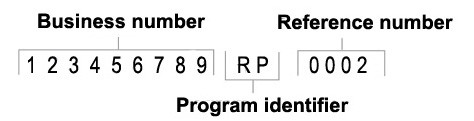
Example:You incorporate a company that will need a GST/HST program account. If you have one or more employees, you will also need a payroll deductions program account.
What happens after registration?
Once registered, your business will receive a:
- CRA Business Number (BN): 123456789
- GST/HST program account number: 123456789 RT 0001
- Payroll deductions program account number: 123456789 RP 0001
If your business does not receive this information, you need to check that the program accounts were registered correctly. If your business needs to confirm their account number(s), you will need to contact the CRA.
Note: If the business incorporates from a sole proprietorship, you will need to register for a new BN. This will generate an RC program account for corporation income tax and you will need to add other CRA program accounts that you require (RP, RT). You will then close the sole proprietor BN accounts if you do not need them for other businesses that you operate. For more information, go to the government’s page on corporate income tax program accounts.
To learn more about how GST/HST works in practice, check out our guide to GST/HST tracking in Canada.
Things to remember:
- Beware of scam websites claiming to provide this info for a fee.
- Double-check the number’s format, as it varies by country.
Business incorporation number vs. other business identifiers
Your incorporation number isn’t the same as your CRA Business Number (BN), tax ID or GST/HST account. Each serves a different purpose, and mixing them up can cause delays with banks, tax filings or funding applications.
When you first register a business, it’s easy to get lost in the different numbers you’re assigned. Here’s how they compare and why it matters:
1. Business Incorporation Number (Corporation Number)
Assigned when your company is incorporated federally or provincially.
- Stays with your business for life, unless dissolved
- Used for legal identification in government registries and corporate filings
Example: If you incorporate “Maple Tech Inc.” federally, Corporations Canada issues you an 8-digit incorporation number that identifies your company in their database.
2. CRA Business Number (BN)
A 9-digit number issued by the CRA.
- Acts as the root for all your tax accounts
- Required to register for GST/HST, payroll, or import/export accounts
Example: Maple Tech’s BN might be 123456789, and every CRA account (GST/HST, payroll, corporate tax) branches from it.
3. Program Account Numbers (GST/HST, Payroll, etc.)
Extensions of your BN with letters and four-digit codes.
- RT = GST/HST, RP = payroll, RC = corporate tax, etc.
- You can have multiple program accounts linked to one BN
Example: Maple Tech’s GST/HST number would look like 123456789 RT 0001.
4. Tax Identification Numbers (TINs)
General term that can refer to your BN or personal SIN, depending on context.
- Often used in banking or international transactions
You might need your incorporation number when registering with a provincial registry, your BN when filing GST/HST, and your program account number when setting up payroll.
Not sure whether your business needs to register for HST yet? See our guide on when to register for HST as a small business owner in Canada.
What to do if you can’t find your incorporation number
If you can’t find your incorporation number, don’t panic. You can recover it quickly through your official documents, government registries or by contacting your lawyer, accountant or the CRA.
It’s common for business owners to misplace their incorporation number, especially if you registered years ago or changed corporate structures along the way. Don’t worry—there are several straightforward ways to track it down.
1. Check your incorporation documents
Your incorporation number is usually listed on your:
- Articles of Incorporation
- Certificate of Incorporation
- Annual return filings
- Corporate minute book (if maintained by your lawyer or accountant)
If you incorporated federally through Corporations Canada, the number will appear on the Certificate of Incorporation. For provincial incorporations, check your registry-issued certificate or business profile.
2. Search federal/provincial registries
Most jurisdictions make it easy to look up your company by name:
- Federal: Corporations Canada’s online database
- Ontario: Ontario Business Registry
- British Columbia: BC Registries and Online Services
Example: If you registered “ABC Consulting Inc.” in Ontario, you can search the Ontario Business Registry by business name and retrieve your incorporation number instantly.
3. Contact your registry office
If online searches don’t work, call Corporations Canada or your provincial business registry. You’ll usually need to provide your legal business name, date of incorporation and possibly director names to confirm your identity.
4. Ask your lawyer or accountant
If a professional handled your incorporation, they’ll often have copies of your filings and can provide the number quickly.
5. Confirm with the CRA
If you’ve already registered for tax accounts, the CRA may be able to reference your incorporation number when you contact them through My Business Account or by phone.
Tip: Avoid third-party sites that charge fees, as the number is always free to access.
How to update your business information in 2026
Most updates to your business information, like changes to address, directors or ownership, must be filed online within strict timelines. Missing these updates can trigger late fees, rejected filings or even dissolution.
Keeping your incorporation record up-to-date is more than just good housekeeping. Federal and provincial registries use this information to verify your legal status and the CRA relies on it to match your tax accounts.
What you must update:
- Address changes (head office or mailing address)
- Directors and officers (appointments, resignations, or name changes)
- Ownership or share structure (new shareholders, share transfers)
- Legal name changes of the corporation
- Contact details (phone, email) used for official correspondence
Example: If Maple Tech Inc. moves offices in March 2026, it must file a change of registered office address within 15 days federally.
How to file updates in 2026
- Federal corporations: Use Corporations Canada’s Online Filing Centre
- Provincial corporations: Use your province’s online business registry (e.g., Ontario Business Registry, BC Registries, Alberta Corporate Registry)
- CRA updates: Log into My Business Account to update business address, directors, or contact persons linked to your BN and program accounts
Deadlines to know
- Most federal and provincial registries require changes to directors or office addresses to be filed within 15 days
- CRA updates should be made as soon as possible to prevent mismatched records
Deadlines can vary by province, so always check the rules for your jurisdiction to stay compliant.
When your business details change, don’t forget to update linked financial accounts and expense management systems. For example, Float automatically syncs with your corporate details and accounting software, helping ensure your spend records and CRA program accounts stay accurate after updates.
Tip: Set a recurring reminder (quarterly or bi-annually) to review your corporate records.
Common incorporation number issues and solutions
Most incorporation number problems come down to mix-ups, missing records or outdated filings. The good news is they’re usually easy to fix if you know where to look and act quickly.
Running into trouble with your incorporation number isn’t unusual. Here are some of the most common issues and how to solve them:
Number not found in registry search
- Why it happens: Typos in your business name, using a trade name instead of your legal name, or missing annual filings.
- Solution: Double-check the exact legal name on your Certificate of Incorporation. If your corporation hasn’t filed its annual return, your registry listing may be flagged as inactive. Filing overdue returns usually resolves it. Confirm spelling and legal entity name; small typos can block results.
Confusing your incorporation number with your BN
- Why it happens: Both are nine-digit numbers but serve different purposes.
- Solution: Remember that your incorporation number identifies your company with Corporations Canada or your provincial registry, while your BN is used with the CRA for taxes. Keep both recorded in one place to avoid mix-ups.
Old sole proprietorship accounts still active
- Why it happens: You incorporated but didn’t close your original sole proprietorship BN.
- Solution: Contact the CRA to close unused program accounts. This avoids duplicate notices or tax filing confusion.
Federal vs. provincial mismatch
- Why it happens: You incorporated federally but didn’t complete required provincial registration or vice versa.
- Solution: Make sure your business is registered in every province where you operate. In many cases, you must file within 15 days of starting operations in a new province.
Lost or missing incorporation certificate
- Why it happens: Paper records get misplaced, especially for older companies.
- Solution: Request a copy directly from your registry or download it online if available.
Tip: Keep a simple record of all identifiers together, including incorporation number, CRA BN and program accounts. If you’re using a finance platform like Float, you can securely store and reference these details directly within your account setup to keep compliance and spending aligned.
Next steps for your business
Your incorporation number is the anchor for your company’s legal and financial identity. With 2026’s digital-first processes, stricter filing rules and compliance requirements, keeping it handy and up-to-date avoids costly delays.
Float helps Canadian businesses put this structure into practice, from verifying incorporation details at onboarding to streamlining expenses, GST/HST tracking and monthly reporting.
See how Float’s corporate cards work for Canadian businesses.
Your questions, answered
Is my business incorporation number the same as my tax ID?
For Canadian businesses, the business number (BN) issued by the Canadian Revenue Agency (CRA) typically serves as the federal tax ID.
How long does it take to get a business incorporation number?
It varies, but typically you’ll receive it within a few days to a few weeks after registering your business.
Can I change my business incorporation number?
Generally, no. This number stays with your business for its entire life.
What if I can’t find my business incorporation number anywhere?
Don’t panic! Contact your local business registry or corporate affairs office. They can help you retrieve it.
Remember, your business incorporation number is a key part of your company’s identity and staying organized with your financial systems helps you put that structure into practice. Tools like Float help Canadian businesses connect their corporate identity to everyday finance management—from expense tracking to CRA compliance—all in one place.